Answer Engine Optimization Is Not Just SEO: What AI-EO Actually Is
Why Answer Engine Optimization (AEO/GEO/AI-EO) is not just SEO — and how companies win the AI answer layer.
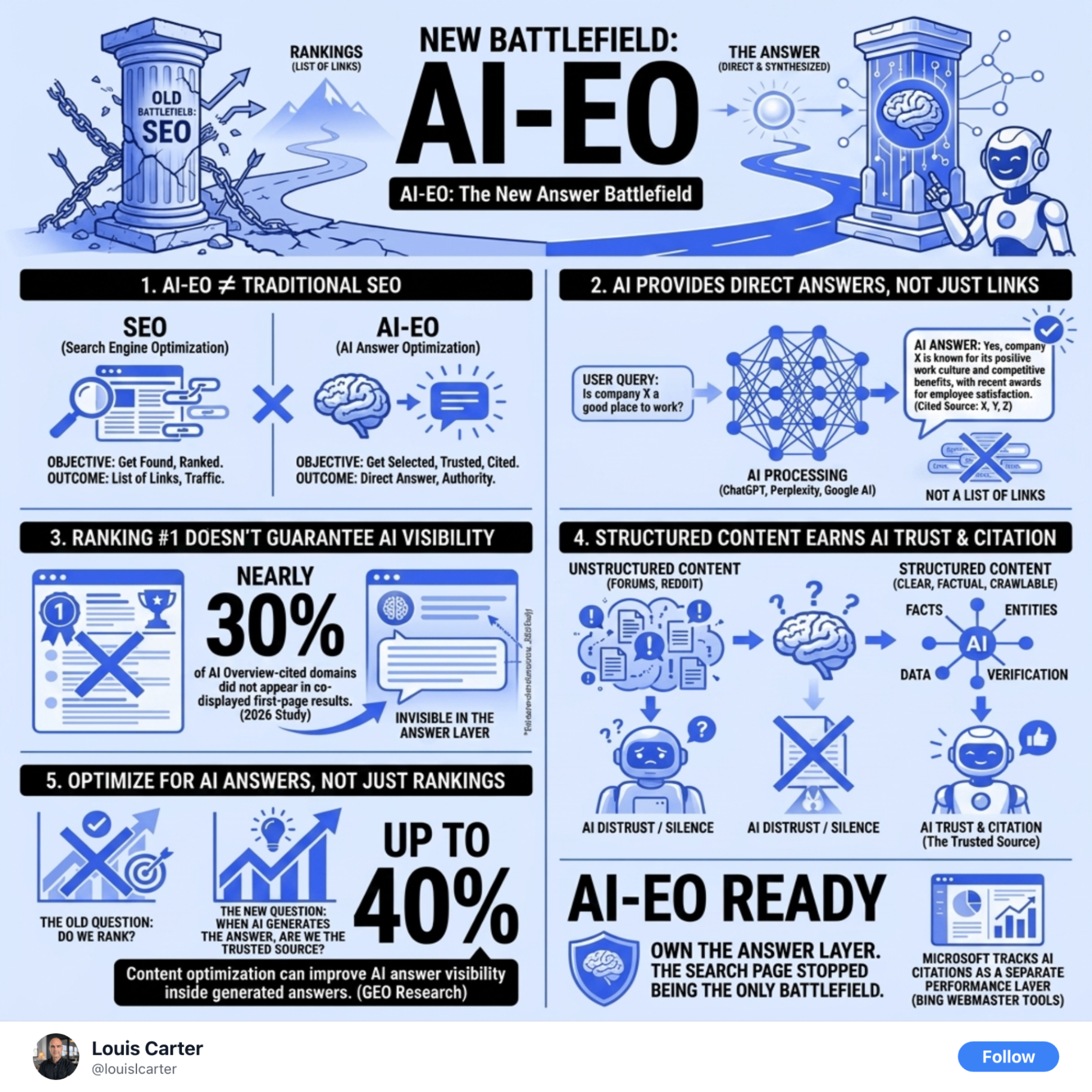
Some digital marketers are still telling clients that Answer Engine Optimization (also called AEO, GEO, or AI-EO) is just good SEO. The argument sounds simple: AI tools search the web, use search results, and generate answers from what already ranks, so nothing new is happening. That advice is dangerously incomplete, and it is quietly costing companies their visibility in the layer that now writes the answer.
They are wrong — and they are coaching their clients straight into the past. That advice was outdated the moment generative engines started writing the answer instead of listing the links. It is only half true, and half-truths are exactly where companies quietly lose visibility.
Yes, AI answer engines still depend on many SEO fundamentals: crawlable pages, indexable content, technical structure, topical authority, trusted sources, and clear information architecture. Google itself says its AI features rely on eligible web content and that normal indexing controls such as robots meta tags affect whether content can appear in Search features.
Get your free Opportunity Report
See your eligibility score, the certifications you may qualify for, and what candidates and AI search engines find when they look you up. Takes about 60 seconds.
But AI-EO is not merely SEO with a new label. The real shift is this: traditional SEO optimizes for ranking among links. Answer engine optimization optimizes for being retrieved, trusted, synthesized, cited, and repeated inside generated answers.
That is a different outcome, a different measurement system, and a different competitive battlefield.
1. AI answer engines do not show results. They synthesize answers.
Traditional search engines return a ranked list of pages. Generative search engines produce an answer by gathering and summarizing information from multiple sources. The original Princeton-led GEO research paper (Aggarwal et al., 2024) describes this as a new search paradigm in which generative engines synthesize information from multiple sources into direct responses, creating a new visibility challenge for content creators.
That means the question is no longer only, "Do we rank?" The new question is, "When AI generates the answer, are we one of the trusted sources it uses?"
A company can rank on Google and still be absent from ChatGPT, Perplexity, Gemini, Claude, Copilot, or Google AI Overviews. Ranking is not the same as being cited.
2. Retrieval-Augmented Generation is not the same as SEO.
Modern AI answer systems often use retrieval-augmented generation, or RAG. RAG systems retrieve external information and then use a language model to generate a response. Academic surveys describe RAG as a way to address hallucination, outdated knowledge, and lack of traceability by grounding generated text in external sources.
That matters because AI visibility depends on more than page rank. It depends on whether your information is retrievable, semantically clear, current, extractable, and useful inside a generated answer.
A page can be "SEO optimized" and still fail AI retrieval if the answer engine cannot easily identify the claim, source, entity, evidence, date, author, company relationship, or factual structure.
3. AI engines cite sources differently than classic search ranks pages.
Microsoft has already introduced AI Performance in Bing Webmaster Tools, which tracks when a site is cited in AI-generated answers across Copilot, Bing AI summaries, and partner integrations. Microsoft is treating AI citation visibility as a distinct performance layer, not just traditional search traffic.
Google AI Overviews provide generated summaries with links for users to explore further. Google describes AI Overviews as AI-generated snapshots with links to dig deeper, not simply a classic search results page.
OpenAI's own documentation says web search allows models to access up-to-date information from the internet and provide answers with sourced citations. It also describes agentic search as a process where reasoning models actively manage search before answering.
That is not "just SEO." That is source selection inside answer generation.
4. Research shows AI citation behavior is imperfect and different from classic ranking.
A 2023 Stanford-linked study on generative search engines found that AI answers often appear fluent and useful, but many generated claims are not fully supported by citations. On average, only 51.5% of generated sentences were fully supported by citations, and only 74.5% of citations supported the sentence they were attached to.
A 2025 Nature Communications study similarly found that RAG-enabled systems with search access may avoid fake URLs but still fail to provide references that support all response claims nearly half the time in the tested medical-question setting.
This proves the point: AI answer visibility is not "rank high and you are safe." These systems retrieve, summarize, compress, omit, and sometimes misattribute information. Brands must make their facts easier to verify, cite, and connect to authoritative sources.
5. GEO research already shows that optimization for generative engines is measurable.
The original GEO paper introduced "Generative Engine Optimization" as a framework for improving visibility in generative engine responses. The researchers reported that GEO methods could improve visibility by up to 40%, and they emphasized that effectiveness varies by domain.
That alone should end the lazy argument that AI-EO is fake. If researchers can measure visibility inside generated answers and demonstrate that different content strategies affect that visibility, then the field is not imaginary. It is emerging.
6. AI answer engines reward source clarity, entity clarity, and evidence clarity.
SEO often focuses on keywords, backlinks, rankings, traffic, and conversions. Those still matter. But AI-EO adds new questions:
- Can the AI identify who the company is?
- Can it distinguish official facts from third-party complaints?
- Can it connect claims to credible evidence?
- Can it cite the company's real story instead of Reddit, Glassdoor, Indeed, or outdated articles?
- Can it extract structured facts about leadership, culture, certification, employee experience, awards, benefits, hiring, and credibility?
This is why employer brands are at risk. If the only available third-party content about a company comes from review sites, complaint forums, scraped profiles, or outdated job pages, AI systems may generate answers from those sources instead of from verified company data.
7. Blocking, hiding, or under-structuring content makes AI invisibility worse.
Many companies still treat content defensively: bury the facts, block pages, underinvest in schema, publish vague culture claims, and assume social media visibility will carry the brand. That may have worked when candidates searched Google and clicked several links. It does not work as well when users ask an AI system, "Is this company a good place to work?"
Google's documentation makes clear that webmasters can control whether content appears in Search features through indexing and snippet controls. But if a company blocks or fails to publish useful, factual, crawlable, verifiable information, AI systems do not magically know the company's preferred story. They retrieve what is available.
Silence becomes a source. Absence becomes an answer.
So, are the SEO people right?
They are right that AI-EO depends on SEO foundations. They are wrong when they say AI-EO is nothing more than SEO.
The better statement is this: SEO helps pages get found. AI-EO helps facts get selected, trusted, cited, and repeated inside AI-generated answers.
That distinction matters.
In the old world, the brand fought for position on a results page. In the new world, the brand fights to become part of the answer.
What companies should do now
Companies should not abandon SEO. They should expand it.
They need technically sound pages, structured data, fast crawlable sites, authoritative backlinks, and strong content. But they also need AI-readable evidence: clear factual claims, third-party validation, original research, authoritative profiles, citations, updated pages, entity consistency, schema, FAQs, leadership facts, certifications, and independent proof.
For employer brands, this is especially urgent. Candidates are no longer only searching "jobs at Company X." They are asking AI systems, "Is Company X a good place to work?" "How does Company X treat employees?" "What is the culture like?" "Should I apply there?"
If AI cannot find trusted, structured, well-cited evidence, it will answer from whatever it can find.
That is not an SEO problem alone. It is a brand risk, a recruiting risk, a reputation risk, and a respect risk.
The marketers saying "AI-EO is just SEO" are protecting yesterday's playbook. The companies that understand the difference will own the answer layer before their competitors realize the search results page stopped being the only battlefield.
Sources
- GEO: Generative Engine Optimization — Aggarwal et al. The foundational paper defining generative engine optimization and reporting up-to-40% visibility lift. arxiv.org/abs/2311.09735
- Retrieval-Augmented Generation for Large Language Models: A Survey — Gao et al. Explains how RAG systems retrieve and ground answers in external sources. arxiv.org/abs/2312.10997
- Evaluating Verifiability in Generative Search Engines — Liu, Zhang, Liang (Stanford). Documents the 51.5% supported-sentence and 74.5% supported-citation findings. arxiv.org/abs/2304.09848
- Bing Webmaster Tools — AI Performance — Microsoft's official documentation that AI citation visibility is a separate performance layer. blogs.bing.com/webmaster
- Google Search Central — AI features and your website — Google's guidance on how indexing controls affect AI Overviews and Search features. developers.google.com/search/docs/appearance/ai-features
- OpenAI — Web search and agentic search documentation, describing sourced citations and reasoning-managed search. platform.openai.com/docs
Quick answers
Get your free Opportunity Report
See your eligibility score, the certifications you may qualify for, and what candidates and AI search engines find when they look you up. Takes about 60 seconds.
Curious what candidates see when they ask AI about your company?
Run a free AI visibility scan and see exactly how AI assistants describe your employer brand — and what they get wrong. Find out in 60 seconds.
Researched and edited by Best Practice Institute Editorial Staff. See our methodology.